Showing posts with label horror films. Show all posts

Monday, March 28, 2011

The Creeper

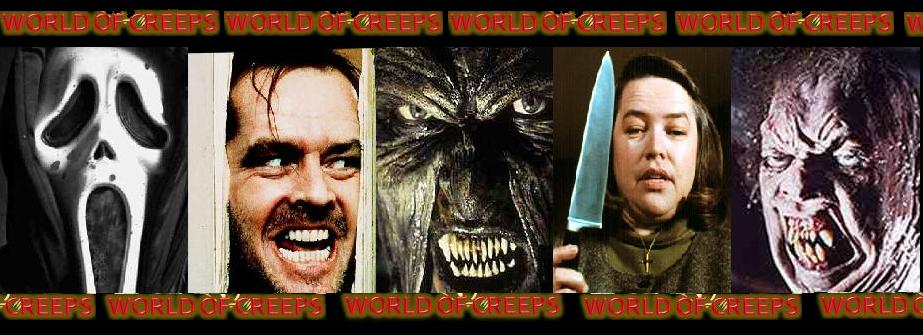
The Creeper is a fictional character and the main antagonist in the 2001 horror film Jeepers Creepers and its 2003 sequel Jeepers Creepers II. He is an ancient, demonic being who feeds on human beings for 23 days every 23rd spring. He is played by Jonathan Breck. Specific details regarding The Creeper's origin (i.e. what he is or how he came to be) have not, as of yet, been specified. Director Victor Salva has stated that the creature's nature is, in part, intentionally left ambiguous for thematic effect

The Creeper has the ability to regenerate any part of his body by consuming a matching human body part. This allows him to replenish his deteriorating body and maintain a state of immortality. The ability also functions as a form of healing factor, as he can intentionally discard an injured or maimed body part and simply devour a replacement. In addition to his regenerative powers, The Creeper is also quite resilient. In the first film, he is run-over several times by Trish and Darry in their vehicle, yet he still manages to escape and heal himself. In the second film, The Creeper is impaled several times with large harpoons, breaks both of his wings, suffers multiple limb amputations and head wounds, and yet still he continues to pursue his prey with the use of only an arm and a leg. He can also crawl on walls like a spider. The Creeper seemingly ceases his activities only when he begins hibernating at the end of his 23 day feeding period. He is, however, shown to have a sense of pain, screaming when injured or attacked severely.Physiologically, The Creeper is only partially humanoid. His skin appears to be leathery and is pale green in color. He has long pointed fingernails, talons on his feet, razor sharp teeth, a pair of large wings (resembling those of a bat) on his back, and another wing-like appendage protruding from the back of his neck. In both films, The Creeper is depicted as strong enough to lift his own body weight and at least one adult human. In the second film, he is shown to throttle and lift a pick-up truck while he is in flight. The Creeper's flying speed is undetermined, but has been seen to easily match that of a speeding automobile. The Creeper possesses an obscure sense of smell which allows him to sniff out specific body parts in his victims which are fit for his consumption. Functioning through an extra pair of nostrils near the bridge of his nose, this sense is especially keen to targets experiencing a heightened state of fear.
The Creeper employs a variety of weapons in his pursuit of prey. He commonly carries daggers, shuriken, and other small weapons all fashioned from the flesh and bones of his victims. He also possesses a medieval battle axe, which he uses to decapitate one of his victims in the first film. The Creeper seems fond of throwing weapons, which he uses with deadly pinpoint accuracy, so much that it creates the illusion that the weapons are moving of their own accord.The Creeper also drives a decrepit Chevrolet COE truck which he uses to transport bodies to his hideouts, most commonly, the basement of an abandoned church dubbed "The House of Pain." He also uses this truck to frighten potential victims and force them off of the road. The truck seems to have been modified, and can reach speeds of at least 100MPH despite its damaged exterior. The license plate reads "BEATNGU" ("Be Eating You", mistaken by Darry in the first film as "Beating You").

Friday, June 25, 2010

Michael Myers ~ Halloween

Micheal Myers
A common characterization is that Michael Myers is evil. John Carpenter has described the character as "almost a supernatural force - a force of nature. An evil force that's loose," a force that is "unkillable"Professor Nicholas Rogers elaborates, "Myers is depicted as a mythic, elusive bogeyman, one of superhuman strength who cannot be killed by bullets, stab wounds, or fire." Carpenter's inspiration for the "evil" that Michael would embody came when he was in college. While on a class trip at a mental institution in Kentucky, Carpenter visited "the most serious, mentally ill patients".
Micheal Myers
Among those patients was a young boy around twelve to thirteen years-old. The boy gave this "schizophrenic stare", "a real evil stare", which Carpenter found "unsettling", "creepy", and "completely insane". Carpenter's experience would inspire the characterization Loomis would give of Michael to Sheriff Brackett in the original film. Debra Hill has stated the scene where Michael kills the Wallace's German Shepherd was done to illustrate how he is "really evil and deadly".

micheal myers
Describing aspects of Michael Myers which he wanted to explore in the comic book Halloween: Nightdance, writer Stefan Hutchinson mentions the character's "bizarre and dark sense of humor", as seen when he wore a sheet over his head to trick a girl into thinking he was her boyfriend, and the satisfaction he gets from scaring the characters before he murders them, such as letting Laurie know he is stalking her. Hutchinson feels there is a perverse nature to Michael's actions: "see the difference between how he watches and pursues women to men". Nightdance artist Tim Seeley describes the character's original personality—his personality in John Carpenter's 1978 film—as "a void", which allows the character to be more open to interpretation than the later sequels alloted him. He surmises that Michael embodies a part of everyone; a part people are afraid will one day "snap and knife someone", which lends to the fear that Michael creates on screen.
Micheal Myers
micheal
A study was conducted by California State University's Media Psychology Lab, on the psychological appeal of movie monsters—Vampires, Freddy Krueger, Frankenstein's monster, Jason Voorhees, Godzilla, Chucky, Hannibal Lecter, King Kong, and The Alien—which surveyed 1,166 people nationwide (United States), with ages ranging from 16 to 91. It was published in the Journal of Media Psychology. In the survey, Michael was considered to be the "embodiment of pure evil"; when compared to the other characters, Michael Myers was rated the highest. Michael was characterized lending to the understanding of insanity, being ranked second to Hannibal Lecter in this category; he also placed first as the character who shows audiences the "dark side of human nature". He was rated second in the category "monster enjoys killing" by the participants, and believed to have "superhuman strength". Michael was rated highest among the characters in the "monster is an outcast" category


Friday, June 18, 2010

Jason Voorhees ~ Friday the 13th

Jason Voorhees is a fictional character from the Friday the 13th series of slasher films. He first appeared in Friday the 13th (1980) as Mrs. Voorhees' son, portrayed by Ari Lehman. Created in combination by Victor Miller, Ron Kurz, Sean S. Cunningham and Tom Savini, he was never intended to carry the series as the main villain. Jason Voorhees has also been represented in numerous novels, comic books, and a cross-over film with another horror legend, Freddy Krueger.
The character has primarily been an antagonist in the films, whether by stalking and killing the characters, or acting as a psychological threat to the lead character, as is the case in Friday the 13th: A New Beginning. Since Lehman's portrayal, the character has been represented by numerous actors and stuntmen, sometimes by more than one at a time; this has caused some controversy as to who should receive credit for the portrayal. Kane Hodder is the most well known of the stuntmen to portray Jason Voorhees having played the character in four consecutive films.

In his original appearance, Jason was scripted as a mentally disabled young boy Since Friday the 13th, Jason Voorhees has been depicted as a non-verbal, indestructible, machete-wielding mass murderer.With the exception of flashbacks of Jason drowning as a child, and a brief scene in Jason Goes To Hell where his spirit is possessing another body, the character has never spoken in any of the sequels to the original Friday the 13th. Online magazine Salon's Andrew O'Hehir describes Jason as a "silent, expressionless...blank slate." When discussing Jason psychologically, Sean S. Cunningham stated, "...he doesn't have any personality. He's like a great white shark. You can't really defeat him. All you can hope for is to survive." Since Friday the 13th Part VI: Jason Lives, Jason has been a "virtually indestructible" being. Tom McLoughlin, the film's director, felt it was silly that Jason had previously been just another guy in a mask, who would kill people left and right, but get "beaten up and knocked down by the heroine at the end." McLoughlin wanted Jason to be more of a "formidable, unstoppable monster

Many have given suggestions as Jason's motivation for killing. Ken Kirzinger refers to Jason as a "psychotic mama's boy gone horribly awry...Very resilient. You can't kill him, but he feels pain, just not like everyone else." Kirzinger goes on to say to Jason is a "psycho-savant", and believes his actions are based on pleasing his mother, and not anything personal. Andrew O'Hehir has stated, "Coursing hormones act, of course, as smelling salts to prudish Jason, that ever-vigilant enforcer of William Bennett-style values."[Todd Farmer, writer for Jason X, wrote the scene where Jason wakes from cryonic hibernation just as two of the teenagers are having sex. Farmer liked the idea that sex acts triggered Jason back to life. Whatever his motivations, Kane Hodder believes there is a limit to what he will do. According to Hodder, Jason might violently murder any person he comes across, but when Jason Takes Manhattan called for Hodder to kick the lead character's dog, Hodder refused. When it comes to hurting a dog, Hodder believes Jason would not act with disregard
A study was conducted by California State University's Media Psychology Lab, on the psychological appeal of movie monsters, which surveyed 1,166 people nationwide (United States), with ages ranging from 16 to 91. It was published in the Journal of Media Psychology. Many of the characteristics associated with Jason Voorhees were appealing to the participants. In the survey, Jason was considered to be an "unstoppable killing machine." Participants were impressed by the "cornicopic feats of slicing and dicing a seemingly endless number of adolescents and the occasional adult." Out of the ten monsters used in the survey — which included Vampires, Freddy Krueger, Frankenstein's monster, Michael Myers, Godzilla, Chucky, Hannibal Lecter, King Kong, and the Alien — Jason scored the highest in all the categories involving killing variables.


Friday, June 11, 2010

SADAKO YAMAMURA ~ THE RING

Sadako Yamamura
is the antagonist in Koji Suzuki's novel Ring and the 1998 film adaptation. She returns as the antagonist in Rasen, is the protagonist in Ring 0: Birthday, and appears in the Korean and American remakes of the Ring cycle films.
In the original novel, Sadako was portrayed with testicular feminization syndrome, meaning that she was anatomically male. In both the novels and movies, it is possible to infer that she is the daughter of some oceanic based entity, making her a quasi-oceanic demigod.
Her name combines the Japanese words for "chaste" (sada) and "child" (ko).

The most recognizable image of Sadako is a shadowy woman whose face is covered in hair, crawling out of a television. This appearance is typical of Japanese ghosts, who are known as yūrei. Specifically, Sadako is a type of yūrei known as an onryō, a yūrei bound by a desire for vengeance.
Yūrei are Japanese ghosts, ones who have been bound to the physical world through strong emotions which do not allow them to pass on. Depending on the emotion that binds them, they manifest as a particular type of ghost.
Like many creatures of folklore, yūrei have a traditional appearance and follow a certain set of rules. They are generally female, although male yūrei do exist. They wear white clothing, which is the color of clothing that corpses are traditionally dressed with in Japan. They have long, often unkempt black hair and white faces, which comes from Kabuki theater where each character has a particular type of wig and make-up that identifies them to the audience. (Although it may also come from the fact that while Japanese women usually wore their hair in a bun, for funeral and burial, their long hair is let loose)
In addition to the standard yūrei appearance, Sadako is also an amalgamation of two famous Japanese ghosts, Oiwa and Okiku. From Oiwa, Sadako takes the single, misshapen eye. From Okiku, the style of murder, of being thrown down a well and then having the ghost rise from the well to seek vengeance.
The success of the 1998 film Ring brought the image of the yūrei to Western popular culture for the first time, although the image has existed in Japan for centuries. This image is often used in J-Horror films, such as Ju-on (and its remake The Grudge), One Missed Call and Dark Water.


The videotape
Main article: The Cursed Videotape
In the films her method of killing with the video curse is not explained, but when someone is killed by it she is seen climbing out of the nearest reflective surface (the most famous portrayal of this being her crawl from a television screen) and approaching them. The corpses are discovered with looks of unearthly anguish on their faces, so it could be concluded that they "die of fright", i.e. a heart attack. In Rasen, the curse is explained in detail, and is discovered to in fact be a virus. When someone watches the cursed tape (or something else carrying the curse) some of their DNA is changed to become that of the Ring Virus (i.e. a hybrid of Sadako's DNA and that of the smallpox virus). This travels through their body and in most cases causes a sarcoma to form on one of the arteries of their heart. If the curse has not been appeased within seven days, the sarcoma detaches from the artery and clogs it, causing heart failure.
Other powers
In Ring 0 Sadako exhibits a variety of abilities (mentioned above), including telekinesis, the ability to kill people instantly with psychic powers, healing abilities, ESP, and possibly the ability to split herself into two beings and merge them again.
Due to her curious new biology, Sadako also seems to be able to resurrect people (with some help from a genetic scientist) at the end of Spiral.
In Ring 2 the protagonists discover that Sadako was alive in the well for 30 years, dying shortly before she was uncovered in the previous film by Reiko Asakawa. This implies that she had remained alive until she imparted her curse onto the tape, meaning that she also had superhuman endurance and longevity, as well as inedia (the ability to live for extended periods without nourishment).
In the original Japanese films, Sadako's tapes cause their victims to have odd and malformed images when photographed. These images remain until Sadako kills the victim.
Lastly, she imparts her curse onto the video tapes, implying the ability of projected thermography.


Friday, September 4, 2009

PSYCHO

PSYCHO
http://images.amazon.com/images/P/B00000IQVC.01.LZZZZZZZ.jpg
Psycho is an American 1960 suspense/horror movie directed by Alfred Hitchcock, from the screenplay by Joseph Stefano. The film is based on the novel of the same name by Robert Bloch, which was in turn inspired by the crimes of Wisconsin serial killer Ed Gein. There's also a 1998 remake of this film

The story starts with Marion, In need of money to marry her boyfriend Sam Loomis, Marion Crane steals $40,000 from her employer and flees Phoenix, Arizona by car. While en route to Sam's California home, she parks along the road to sleep. A highway patrol officer awakens her and, suspicious of her agitated state, begins to follow her. When she trades her car for another one at a dealership, he notes the new vehicle's details. Marion returns to the road but, rather than drive in a heavy storm, decides to spend the night at the Bates Motel.
http://mmimageslarge.moviemail-online.co.uk/Psycho_01875_rgb.jpg


Owner Norman Bates tells Marion he rarely has customers because of a new interstate nearby and mentions he lives with his mother in the house overlooking the motel. He invites Marion to have supper with him. She overhears Norman arguing with his mother about letting Marion in the house, and during the meal she angers him by suggesting he institutionalize his mother. He admits he would like to do so, but does not want to abandon her.http://www.scene-stealers.com/wp-content/uploads/2009/01/psycho13ro4.jpg

Marion resolves to return to Phoenix to return the money. After calculating how she can repay the money she has spent, Marion dumps her notes down the toilet and begins to shower. An anonymous female figure enters the bathroom and stabs her to death. Finding the corpse, Norman is horrified. He cleans the bathroom and places Marion's body, wrapped in the shower curtain, and all her possessions — including the money — in the trunk of her car and sinks it in a nearby swamp.

Shortly afterward, Sam is contacted by both Marion's sister Lila and private detective Milton Arbogast, who has been hired by Marion's employer to find her and recover the money. Arbogast traces Marion to the motel and questions Norman, who unconvincingly lies that Marion stayed for one night and left the following morning. He refuses to let Arbogast talk to his mother, claiming she is ill. Arbogast calls Lila to update her and tells her he will contact her again after he questions Norman's mother.

http://www.channel4.com/film/media/images/Channel4/film/P/psycho_1998_xl_02--film-A.jpg


Arbogast enters Norman's house and at the top of the stairs is attacked by a figure who slashes his face with a knife, pushes him down the stairs, then stabs him to death. When Arbogast does not call Lila, she and Sam contact the local police. Deputy Sheriff Al Chambers is perplexed to learn Arbogast saw a woman in a window, since Norman's mother died ten years ago. Norman confronts his mother and urges her to hide in the cellar. She rejects the idea and orders him out of her room, but against her will Norman carries her to the cellar.

Posing as a married couple, Sam and Lila check into the motel and search Marion's room, where they find a scrap of paper in the toilet with "$40,000" written on it. While Sam distracts Norman, Lila sneaks into the house to search for his mother. Sam suggests to Norman that he killed Marion for the money so he could buy a new hotel. Realizing Lila is not around, Norman knocks Sam unconscious and rushes to the house. Lila sees him and hides in the cellar where she discovers the semi-preserved and mummified body of Norman's mother. Wearing his mother's clothes and a wig and carrying a knife, Norman enters and tries to attack Lila, but she is rescued by Sam.

http://www.freewebs.com/september-java/psycho98.JPG

After Norman's arrest, forensic psychiatrist Dr. Fred Richmond tells Sam and Lila that Norman's dead mother is living in Norman's psyche as an alternate personality. After the death of Norman's father, the pair lived as if they were the only people in the world. When his mother found a lover, Norman went over the edge with jealousy and murdered both of them. Consumed with guilt, he tried to "erase the crime" by bringing his mother back to life in his mind. He stole her corpse and preserved the body. When he is "Mother", he acts, talks, and dresses as she would. Norman imagined his mother would be as jealous of a woman to whom he might be attracted just as he was of his mother's lover, and so "Mother" kills any woman he has feelings for; when Norman regains consciousness, he believes that his mother has committed the crime, and covers up for her. It is implied that Norman is responsible for the unsolved disappearances of two young girls. Richmond concludes that the "Mother" personality has now taken complete control of Norman's mind.

In the final scene, Norman sits in a cell, thinking in "Mother"'s voice. In a voiceover, "Mother" explains that she plans to prove to the authorities she is incapable of violence by refusing to swat a fly that has landed on her hand. The final shot shows Marion's car being recovered from the swamp.

http://film.virtual-history.com/photo/05/large/05589.jpg